Showing posts with label That Went...Alright. Show all posts

November 11, 2010

The Trouble with Cooking Lemon Grass is...

So, I had been dying to make a super cool recipe from my copy of Art of the Slow Cooker called Curried Coconut Chicken Soup. It called for lemon grass, which I couldn't find anywhere around Emerald Isle or Jacksonville.

I was finally able to find what I thought would be a decent compromise at a mid-range grocery store last week:


Ah yes, the "herb blend." I bought it because I was frustrated by searching for the real thing and having produce section attendants look at me like I was high or, at least, highfalutin when I asked if they ever carried lemon grass.

I paid in frustration, and, once home, proceeded to check the ingredients. This is literally the exact opposite of all healthy eating advice I've ever heard. Anyway, here's what I found:

Lemon Grass, Canola Oil, Dextrose, Whey (milk), 
Sodium Lactate, Glycerine, Fructose, Salt, Maltodextrin, 
Sodium Ascorbate to help protect flavor, 
Citric Acid to promote color retention, 
Zantham Gum, Ascorbic Acid to promote color retention

Jeesh. That's a lot of crap. But wait! There's more! Because when I looked just below the list of ingredients, what did I spy? 

MADE IN AUSTRALIA

So, I had not only purchased a faux-herb blend. I had also endorsed the practice of making said herb blend and flying it HALFWAY AROUND THE WORLD. Great. Really green of me.

Luckily, I happened to be near a Harris Teeter two days ago, and found the real thing in its lovely, enormous, and wonderfully-lit produce department. I bought twice the amount the recipe called for, and headed home, wondering what on earth I was going to do with the "herb blend" sitting in my fridge.

And then I discovered why cooking with lemon grass is a bit of a pain.
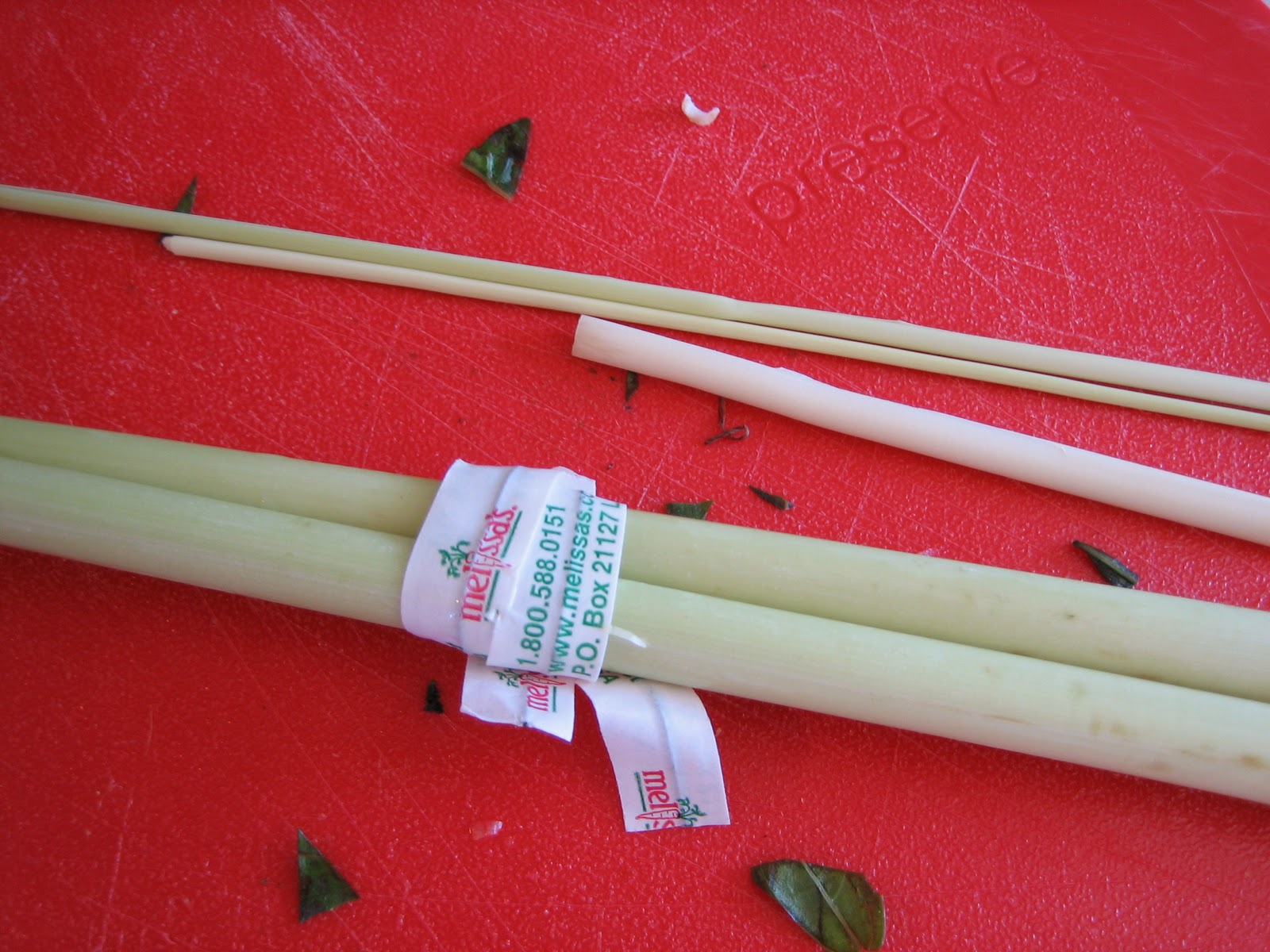

See the nice, thick stalks of lemon grass at the bottom of the picture? Now, see the reeeeally skinny stalks at the top of the picture? That's all you get. The outer layer of lemon grass is so tough that, unless you boil the entire thing for a few hours to get lemon grass stock (and who doesn't want that?), you probably only end up consuming about 1/8th of each actual stalk if you're just going to chop it up for a soup or a stir fry.


See that? It's all trash. Very frustrating.

So here's my problem: when it comes to lemon grass (which is, truly, a delicious flavor), our options are either to pay a billion dollars for enough fresh stalks to yield something substantial, or to pay a million dollars for a bunch of yuck to be flown halfway around the world for us.

This seems stupid. No?

Anyway, my soup ended up delicious, even if I couldn't really taste the lemon grass all that much. This was one of those classic endeavors that make T have a panic attack every time he thinks about our food budget.

April 27, 2010

Homemade Stuffed Grape Leaves (an Attempt)

I'm not sure what it was that made me want to try making my own stuffed grape leaves, but I decided that it was a necessary endeavor. I love stuffed grape leaves, and I think it's pretty tough to find decent canned ones, so making my own made sense so that I could a) spend less money on them, and b) control the ingredients and keep them healthy.

It took me a ridiculous amount of time to find grape leaves. Whole Foods doesn't carry them, World Market doesn't carry them, not even the ambiguous "eastern" markets in Richmond carry them. I had given up and decided to stuff tomatoes, when I headed to the International Foods section of my local Kroger on a whim. Et voilà! PelePonnese grape leaves! In big jars, containing about 60 grape leaves each.

I decided to use Mark Bittman's recipe for the grape leaf filling, which called for currants (I used raisins), pine nuts, onions, rice, allspice, garlic, cinnamon, cayenne pepper, fresh parsley, fresh dill, olive oil, and salt and pepper.

Being me, I added too much allspice and then forgot to add the fresh dill and parsley, which resulted in really sweet filling. Next time, I'll probably only add a sprinkle of allspice and cinnamon, and focus instead on fresh herbs and salt and pepper.

I probably also could have a) blanched the grape leaves for longer, and b) cooked the stuffed grape leaves for longer. They weren't too tough, but they were just a couple of minutes shy of tender, which makes eating them really awkward because the leaves don't tear very easily.

Don't get me wrong--for a first attempt, these stuffed grape leaves were pretty successful. But I know I can make them even better now that I've tried it once. My next batch will feature dill, parsley, mint, and celery salt. Maybe even some shredded carrot?

March 29, 2010

Proof: Elimination Diet Food is Good Food

I'd like to use this post to show all the naysayers or the people who are afraid to take the elimination diet plunge that it's possible to eat well on this diet. Case in point, my dinner on Saturday night:


Rosemary and garlic-rubbed lamb chops, roasted golden beets, sweet potatoes, and onions, and brown rice salad with pea shoots, celery, and avocado. It. Was. Good.

Except, of course, for the part where I undercooked the lamb chops because I was afraid of how much smoke was coming out of the frying pan since I had to cook them over high heat (next time, lower heat). I followed this lamb chop recipe as a base, and then added the rosemary and garlic on a recommendation from one of Jackie's recipes (which requires a grill, which I do not have).

T and I were about five minutes into dinner when he pointed out, as sweet as pie, that the lamb was still totally raw in the center. Of course. So I cut each chunk of lamb meat off the bone and threw the pieces into a frying pan over medium heat for about a minute, and they were fine. They tasted great, in the end, but I wish I had nailed them the first time (that's what she said?).

This week begins a no-meat phase of the elimination diet. Shouldn't be too bad, as I can't afford to buy meat that regularly in the first place (P.S. lamb chops are expensive!). Now, let's see how many ways I can cook chickpeas in the next few days...

December 15, 2009

Oh My Darling: Clementine Clafoutis

For a dinner party last night, I decided to continue the French cooking trend and try my hand at a clafoutis, which is essentially a fruit tart (traditionally with cherries) made with a custardy batter (sounds like custody battle) consisting of egg, milk, yogurt, sugar, and flour.

Because I'm leaving for the holiday break in about a week, I'm anxious to use up as much of the produce I have in the house as possible. As a result, I chose to make a clementine clafoutis with seven clementines that needed a home, loosely following Mark Bittman's clementine clafoutis recipe.

The clafoutis turned out to taste great, but, to be totally honest, clementines are awkward to cut around and make for a less than smooth eating experience. The clafoutis batter is deliciously smooth and creamy when cooked, but the clementines remain kind of...clementine-y, which is to say tough. So if you're looking for a great taste but are open to a kind of lovably imperfect experience, clementine clafoutis is worth trying.

Side note: I tried a clafoutis earlier this month with apples that was perfect, so I guess my advice is that it all depends on the type of fruit you use and how well it softens up in the oven (the softer, the better).

Clementine Clafoutis
  • Six or seven clementines, peeled, sectioned, and de-seeded
  • 3 eggs
  • 1/2 cup white sugar
  • 3/4 cup milk (I used 2%)
  • 3/4 cup yogurt (I used nonfat plain)
  • Pinch of salt
  • Tsp. vanilla
  • Tbsp. clementine zest
1. Preheat the oven to 350 degrees. Once you've spent the time peeling, sectioning, and deseeding (aka manhandling) the clementines, arrange them in a buttered and floured baking dish in any way you see fit.


2. Beat the eggs until they froth, then add the sugar and mix well. Gently, add the milk, yogurt, and vanilla. Last, add the flour and salt, and stir until the ingredients are just combined. Pour the mixture over the clementines, and put it in the oven for about 30 minutes.


3. Once a knife inserted in the middle of the clafoutis comes out clean and the top is evenly browned, remove the clafoutis from the oven and allow it to sit for about 15 minutes before serving.


4. Enjoy!


I'll admit that peeling and sectioning seven clementines is time-consuming (and helps you find cuts you didn't know you had), but the orangey flavor of the clafoutis is worth it. Imperfect? Yes. Delicious? Also yes.

I'm trying a traditional clafoutis once cherry season rolls around. Now, check out the professional, making a clafoutis look easy...well, easier:

November 24, 2009

Kitt Says Relax: Chilling Out about Thanksgiving


Good evening, this is the pot, and I'm about to call the kettle black. Cooks need to relax in the kitchen, especially around Thanksgiving and the winter holidays. These holidays are about family and the time spent together, not about slaving away in the kitchen and bursting into tears when the roast isn't perfectly cooked.

I came to this realization via a total Kitchen Fail I had while my boyfriend was visiting recently. I'd been cooking a lot and feeling pretty sure of myself in the kitchen, when the night in question occurred and reminded me that I've been cooking pretty much only for myself, and that I am a Master Rationalizer who can cast any failure in a successful light if I try hard enough. And that I'm not very good at strategies.

Enter T, the boyfriend, who is supportive and kind and has been really sweet during other Kitchen Fails. I want to cook a wholesome meal for T that consists of more than one dish, so I decide that the best choice is to cook two things I've never tried making before (sautéed asparagus and herb roasted chicken) and one thing I know pretty well (acorn squash). This does not occur to me as a poor choice.

Since I'm an English teacher, I'll tell you that my tragic flaw is an utter inability to plan things out rationally, especially when under pressure (pressure being my baseless conviction that T will not like me anymore if I cannot manage to cook a decent multi-part meal).

Right around Wheel of Fortune time (7 pm), I start cooking. Instead of putting the acorn squash in the huge toaster oven that's hogging counter space in my kitchen, I decide I'll cook it in the oven and do the chicken after, since the two dishes require different temperatures. Does it occur to me that this eliminates the possibility of eating both dishes fresh out of the oven? Nope!

While I'm waiting for the acorn squash to cook (which takes between 40 minutes and an hour, by the way), I decide I'll make the asparagus. I peel, chop, and sautée the asparagus, and it turns out great. It also turns out to be ready about 40 minutes before the squash, and the chicken is still straight chillin' in the fridge, un-herbed and un-roasted. I get nervous about how long everything is taking and serve T the asparagus, trying to pass it off as a "salad course."

Then, I remove the acorn squash from the oven after a few pokes with a fork indicate that it might be done (it isn't) and put the chicken in to roast for, oh, another 30-40 minutes. By the time T and I have eaten our asparagus, suffered through undercooked acorn squash, and finally eaten some (admittedly tender and juicy) herbed roasted chicken, Jeopardy (7:30 pm) is long gone and The Office (9 pm) has taken over. Planning: Fail. Timing: Fail. Kitchen Fail.

But you know what? That asparagus was pretty damn good (thanks, Mark Bittman), and the chicken was flavorful and juicy. T got some good mileage out of just how faulty my planning skills are, and I got some material to share with you, dear readers, so that I might help you to avoid making the mistakes I make.

Whether you're cooking a meal for twenty or for two, the key is to get over it before you even start. You're just making food for people, and you're doing it to bring them together so that they can talk and laugh and tell embarrassing stories about you while you run to the kitchen for more cranberry sauce.

Let the day happen. Enjoy Thanksgiving, and I'll try to, too.

September 17, 2009

Odds 'n Ends: Roasted Stuffed Peppers

The beginning of the school year is always a bit hectic for students and teachers. On my end, it often leads to a really confusing assortment of food in the fridge--one pepper, half a jar of pickles, the end of a bag of shredded cheese, etc. This is usually the result of my coming home, cramming some food into my mouth, and hunkering down to grade as much as possible before I get to bed.

Last week, however, I had a blessedly empty night on my hands, and decided to try to do something culinary with my time. I wanted to use up a beautiful orange pepper that had been hanging out in the fridge, but didn't have enough salad-type ingredients. I'd been missing the beauty of Greece and its amazing cuisine, and I remembered how delicious the stuffed peppers and tomatoes had been. That's not too hard, I thought.

Well, yes and no.

Roasted Stuffed Pepper Recipe

  • One pepper
  • 1-2 cups of pre-cooked rice (preferably brown)
  • Whatever herbs/spices you have on hand

1. Preheat the oven to 400 degrees. Using a paring knife, make a circle cut around the stem of the pepper, so that you can pull it and the seeds out without damaging the body of the pepper. Save the stem to put back on top during cooking, mostly for aesthetic value.


2. Fill the pepper with the pre-cooked rice, adding any herbs or spices you have on hand (I used fresh garlic, celery salt, and pepper). Add a little olive oil to keep the filling moist (what a terrible word). Cook for 20-ish minutes...longer is better if you prefer a softer pepper.


3. While you wait, try a 3 Horses beer. It's a Dutch lager that a friend brought over for our "Stock the Bar" housewarming party, and it's delicious.


4. Remove the pepper from the oven, and let it cool (with the top off!) for a while before you dig in. Your unburnt tongue will thank you (trust me).


The bottom line: while it was great to use up some random food elements, I should have let the whole thing cook longer. My garlic was more or less raw, which made the whole dish a lot harsher than it should have been. If I hadn't been positively starving while making this lovely stuffed pepper, it probably would've been easier to wait.